

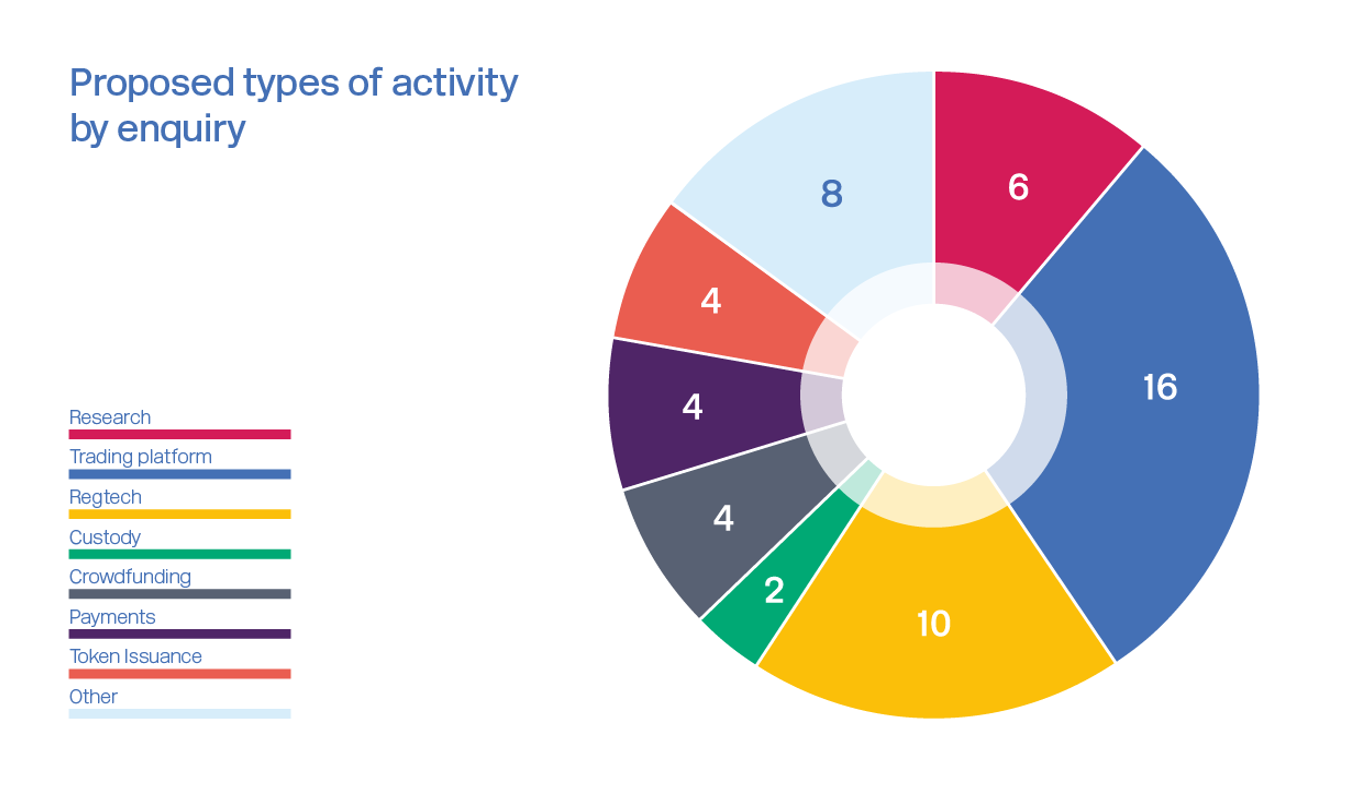
Following the interest in crypto-currencies, Initial Coin Offerings and Security Token Offerings in 2017 and 2018, it is unsurprising that 2019 has seen a dramatic increase in the number of enquiries relating to trading platforms and exchanges.
While it depends on the precise nature of the activity, in most cases, our framework to date is limited to a ‘Schedule 2’ notification relating to Virtual Currency Exchanges which capture platforms which have an element of Fiat currency.
In late 2019, the JFSC published a consultation relating to enhancements to Jersey’s Investment Business regime which included a question on the inclusion of ‘exchange business’, which would provide the JFSC for future powers to regulate and supervise this type of business.
We have assisted a number of individuals with their academic studies, focussing on emerging technologies and we have been able to benefit from the outputs of this work.
The adoption of Regtech by existing firms has meant that we have spent a great deal of time this year listening and understanding how the adoption of Regtech solutions might be able to assist our regulated community and how they might be able to offer an alternative to traditional ways of working within our Industry, while maintaining strong regulatory compliance. Although we do not endorse any particular solution or provider, we have offered feedback or suggestions.
The ‘Other’ section comprises unique business models which are underpinned by technology, including cyber security and financial inclusion – both of which we have had a focus on over the past five years.
Testing
A number of firms approached us asking to operate outside of the regulatory framework exploring with us whether they should engage in live testing. Our advice has generally been that developing a tailored approach to achieving regulatory compliance tends to work better than testing without any regulatory consideration (as test results developed on this basis are often of little use).
Although we appreciate that a ‘regulation free’ or ‘regulation-lite’ environment may allow for flexible thinking, we would like to remind firms that they cannot perform any regulated activities or provide regulated products without having been granted authorisation or registration under the appropriate regime.
We are able to provide guidance to firms on what regime might be appropriate, what the process might look like, and what level of questioning to expect from us.
We have the flexibility to condition licences and consents granted to firms who are not able to meet certain regulatory requirements from day one, providing adequate safeguards are in place. For example, a business might be formed in order to test technology, but not be allowed to have customers until the technology has been demonstrated as effective.
Any bespoke condition is considered on a case-by-case basis. Firms which have, or anticipate, challenges with regulatory requirements should contact us as soon as these have been identified. This will enable us to work with firms to achieve the best outcome.